
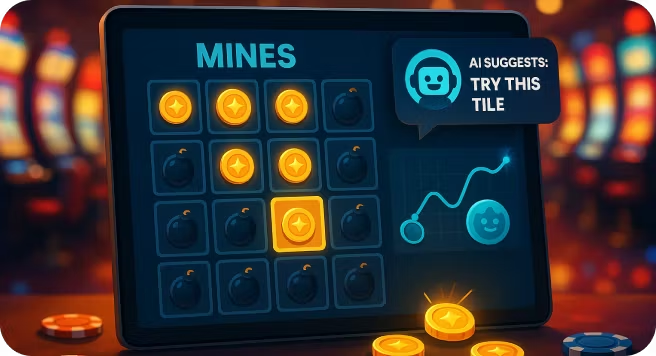
How To Use Chatgpt For Mines Game?

| 🕐 Reading Time | ⭐ Rating | 👁️ Popularity |
|---|---|---|
| 3 minutes | 4.2 ⭐⭐⭐⭐ | 856 views |
A Mines game presents a grid containing hidden mines and safe tiles. Each safe selection may increase the displayed payout, while selecting a mine ends the round under the game’s rules.
ChatGPT cannot see the board’s hidden state or predict mine locations. It can, however, explain probability formulas, compare risk scenarios, and help you review how a sequence of bets could affect your cash balance.
This article shows how to provide useful game parameters, request transparent calculations, and check AI answers before applying them. ChatGPT should be treated as an educational calculation tool, not as a source of guaranteed moves or winnings.
Table of Contents
| Section |
|---|
| Why ChatGPT Can Support Your Mines Game Thinking |
| How to Ask ChatGPT for Mines Strategy |
| How to Combine AI Advice with Smart Human Play |
Why ChatGPT Can Support Your Mines Game Thinking
ChatGPT can organize calculations and explain the assumptions behind them. For Mines, suitable uses include:
Rapid probability calculations: Given the number of unopened tiles and remaining mines, ChatGPT can calculate the probability of a safe selection.
Risk analysis: It can compare the calculated risk of continuing with the option to cash out, where the game rules permit it.
Scenario simulation: You can ask it to compare hypothetical conservative and aggressive betting sequences.
Cash balance management: It can help draft spending, session, and bet-size limits based on figures you provide.
Pattern review: It can summarize previous results or decisions without claiming that past boards predict the next one.
The output is only as reliable as the supplied rules and numbers. Recheck calculations independently, because an AI response can contain errors and cannot affect a randomly generated board.
Example: Martingale Risk Analysis from Stake Mines
Consider a hypothetical Mines round on a 5×5 grid containing 25 tiles and 3 hidden mines. Under a Martingale sequence, the next bet doubles after each unsuccessful round in an attempt to recover previous stakes.
Even when a single selection has a relatively high calculated chance of being safe, consecutive unsuccessful rounds remain possible. The required stakes rise from $1 to $2, $4, $8, and onward, so the total amount committed can exceed a player’s cash balance quickly.
ChatGPT can list the cumulative stake at every step and calculate scenario probabilities using the rules you provide. This demonstrates the financial exposure of doubling systems; it does not make Martingale profitable or remove the game’s house advantage.
AI Prompt Structures for Probability & Risk Insights
To request a useful calculation, include:
Exact grid size (e.g., 5×5, 8×8)
Number of mines hidden
Current board state: how many safe tiles are uncovered
Your cash balance and preset spending limit
Goal of the calculation, such as the probability of several safe selections
For example:
“ChatGPT, I’m reviewing a 5×5 Mines game with 4 mines. Three safe tiles have already been uncovered. Show the formula and calculate the probability that the next 4 selections are safe, assuming no mine locations are known. Then illustrate fixed bet sizes that remain within a cash balance limit I provide.”
This level of detail lets ChatGPT show sequential probability calculations and compare hypothetical bet sizes. Verify that its assumptions match the actual game rules before using the result.
How to Ask ChatGPT for Mines Strategy
Useful prompts clearly separate facts supplied by the game from assumptions introduced for analysis. Mines outcomes are random, so no prompt can disclose the location of a hidden mine.
Key points to include:
Board size: Specify the total tiles, such as a 5×5 (25 tiles) or 8×8 (64 tiles) grid.
Number of mines: State how many mines are hidden.
Current game state: Note how many safe tiles have already been uncovered.
Game rules: Include cash-out options, payout scaling, and relevant mechanics.
Progress in the round: State whether the calculation concerns the start, middle, or later part of a round.
Recent outcomes: Include them only when reviewing your decisions; previous outcomes do not reveal the next board.
Ask ChatGPT to show its formula and intermediate steps. This makes the answer easier to check and reduces the risk of acting on an unexplained figure.
Describe the Board (mines count, grid size, game rules)
Begin your prompt by describing the setup:
Total number of tiles: For example, 25 tiles in a 5×5 grid or 64 tiles in an 8×8 grid.
Number of mines: Specify how many mines are hidden, such as 3, 5, or 10.
Safe tiles uncovered: Mention how many safe tiles you’ve revealed so far.
Game rules: Clarify whether mid-round cash out is available, how payouts scale, and which mechanics affect the calculation.
Providing these details helps ChatGPT identify the correct probability model. Missing or incorrect parameters will produce an unreliable answer.
Ask for Safe-move Scenarios Using Probability
Once the board and rules are established, ask about calculated scenarios:
“On a 5×5 board with 5 mines and 7 safe tiles already revealed, what is the probability that the next 3 selections are safe?”
“Given 3 safe tiles uncovered on an 8×8 grid with 10 mines, what is the chance of uncovering 5 more safe tiles in a row?”
“What is the probability of hitting at least one mine when uncovering 2 more tiles on a 6×6 grid with 8 mines?”
These questions quantify risk but do not identify which tile is safe. Ask for the formula so you can verify the result.
Request Risk Management Advice
ChatGPT can help you draft personal spending limits and compare fixed bet sizes against a stated cash balance. It can also illustrate how quickly progressive systems increase the amount at risk.
Do not treat a suggested cash-out point or bet size as optimal simply because it came from an AI model. The response should be checked against the game rules, your preset limits, and the fact that no betting structure guarantees a profit.
Use Iterative Prompts for Dynamic Decision Making
For an ongoing calculation, update the known board state after each selection:
Describe how many tiles you’ve uncovered safely so far.
State the number of unopened tiles and remaining mines.
Ask for the revised probability and the formula used.
Updated calculations can describe current risk. They still cannot reveal the hidden board or predict the result of the next selection.
How to Combine AI Advice with Smart Human Play
ChatGPT can calculate and explain, but it cannot replace player judgment or access hidden game data. Mines remains unpredictable, and the model may also misunderstand a rule or make an arithmetic error.
Use AI output as a draft calculation. Check the numbers independently, decide your spending and time limits before starting, and avoid chasing an unlucky result. Past boards and apparent patterns do not make a future tile safer.
Human judgment is especially important when deciding whether to stop. ChatGPT cannot know your financial circumstances or reliably assess your emotional state during a session.
A balanced approach uses ChatGPT for transparent probability exercises while leaving control with the player. This can support more structured decisions, but it cannot improve the underlying chance that a hidden tile is safe.
| Pros of AI Support | Cons of AI Support |
|---|---|
| Rapid probability calculations when inputs are correct | Cannot predict exact mine placements |
| Structured explanations of risk and possible rewards | Dependent on the quality and accuracy of your input |
| Compares multiple hypothetical strategies quickly | May produce incorrect or unsuitable recommendations |
| Helps draft cash balance and session limits | Doesn’t update unless you provide the new board state |
FAQ
Can ChatGPT actually predict where mines will be in a Mines game?
No. ChatGPT cannot access the hidden board or predict random mine locations. It can only calculate probabilities from the information supplied.
What details should I provide in my prompt to get useful probability estimates from ChatGPT?
Provide the board size, number of mines, number of safe tiles already uncovered, and the game rules relevant to the calculation.
Can ChatGPT simulate a "1:1 tile" strategy and calculate expected win/loss?
It can model a hypothetical strategy when given accurate probabilities and payout rules. The result is an estimate, not a guarantee of profit.
Is it safe and legal to use ChatGPT for planning Mines game strategy in India?
Using ChatGPT for calculations is separate from the legality of real-money gaming. Gambling rules may vary by jurisdiction, so check the requirements that apply in your location.
What are the key limitations of ChatGPT when analyzing grid-based games like Mines?
Cannot access live or hidden game data
Depends on accurate inputs and rules
Provides theoretical calculations, not guarantees