
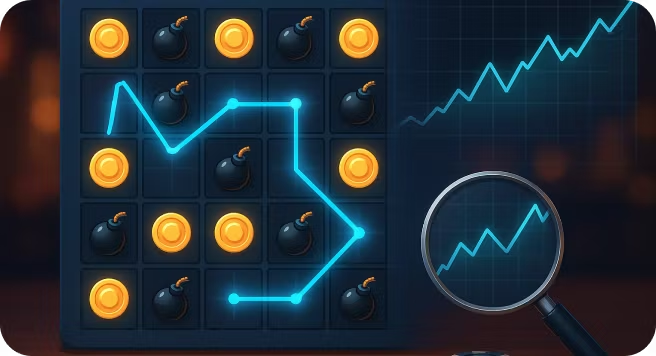
How To Predict Mines Game?
| 🕐 Reading Time | ⭐ Rating | 👁️ Popularity |
|---|---|---|
| 4 minutes | 4.3 ⭐⭐⭐⭐ | 775 views |
How to predict the Mines game is one of the most searched questions about it, and the honest answer is that you cannot. What you can do is play it deliberately. This guide walks through the strategies that circulate most, separating the ones that control your spending from the ones that only claim to read the board.
Along the way: how the provably fair system works, what the probability of a safe tile actually looks like, how to use demo mode without drawing the wrong lessons from it, and how to manage a cash balance. New player or regular, you should finish knowing which methods do something real and which do not.
Table of Contents
| Section |
|---|
| Why Mines Game Isn't "Predictable" |
| Why "1 Mine, 1 Pick" Doesn't Guarantee a Win |
| Most Common Mines Strategies Explained and Debunked |
| How to Use Demo Mode Responsibly (Without Falling for Patterns) |
Why Mines Game Isn't "Predictable"
New players often arrive convinced that the Mines game online can be cracked with enough memorised patterns or the right tool. It runs on a provably fair RNG system, which means every round is generated independently of the last. That single fact is what makes prediction hacks unreliable: there is no sequence underneath to find. Chasing one empties a cash balance faster than most players expect.
The second trap is the Mines predictor App, sold or given away on the promise of guaranteed results. These do not work, and many of them are worse than useless: unverified downloads can carry malware, harvest login details, or breach your betting & casino site's terms and cost you the account. What experienced players use instead is unglamorous and real, namely planned cash-outs, controlled bet sizes, and a stopping point set in advance.
Provably Fair RNG & Seed Hash Verifications
The Mines provably fair RNG system places mines randomly on every board, using cryptographic methods that neither the player nor the site can influence mid-round. With Spribe Mines hash verification, you can check a completed round yourself and confirm the result was not altered. That transparency is worth understanding, because it is also the clearest explanation of why prediction claims fail.
Autoplay settings let you pre-set bet amounts, round counts, and cash-out conditions. The provably fair system applies exactly as before, so no configuration forces a result. Hash verification tools make it straightforward to cross-check the seed against the revealed outcome after each round. Learning to verify results, and using autoplay as a convenience rather than a system, keeps you in charge of the part you actually control.
Each Round Is Completely Independent, No "Pattern" Connection
Every board in the Mines casino game is generated fresh. There is no hidden sequence, no hot or cold tile, no position that becomes safer because of what happened last round. This is why pattern prediction and memory strategies disappoint so reliably: they are reading a record that has no bearing on the next deal.
The belief that mine placements cycle, or that certain squares are safer after an unlucky round, is the most common version of this mistake. Past outcomes carry zero influence forward. Whether you are in demo mode or betting real funds, accepting that each round stands alone is what makes disciplined decisions possible.
Why "1 Mine, 1 Pick" Doesn't Guarantee a Win
Setting a single mine and making one pick is often described as the safe way to play. The risk per round is genuinely lower than a high mine count, and it is not zero. Your one tile can still be the one with the mine under it. The win probability per click always leaves room for chance, and no configuration removes it. Treat this as a lower-risk option, not a solved one.
The approach also erodes over time, particularly if bet sizes climb after each round. Pairing it with a fixed cash-out point and a session limit is what keeps it sensible. Low-mine boards are governed by the same randomness as any other, so patience and a disciplined cash balance matter more than hunting for a safe-looking setup, in real-money mode as much as in free play.
Probability Still Plays the Biggest Role
However carefully you pick, the 5x5 grid probability is what decides each round. Every tile carries a fixed mathematical chance of being safe, and those odds reset with each click. The multiplier probability chart shows the trade directly: higher multipliers mean fewer safe tiles left. Bigger payouts and higher risk are the same thing viewed from two angles, which is worth remembering when a round is going well.
Even with the Mines payout RTP of 97%, that figure is calculated across thousands of rounds rather than the handful you are playing. Short-term variance can run against you as easily as it can run with you. Understanding the probability is mostly a guard against overconfidence during a good run and against chasing during a poor one. Whether you are testing in demo mode or betting real funds, the maths is what drives the outcome.
Demo Mode Misleads With "Sample Bias"
Demo mode teaches the mechanics well, and it can hand you a false sense of security through simple sample bias. Plenty of players hit an unusually good run in practice and carry that expectation into real money, where the variance feels sharper because the cash balance is real. Demo results do not forecast anything.
The other difference is you. The RNG behaves identically, and your decisions do not: real stakes change how it feels to click the next tile, and that is where most of the demo-to-real gap actually lives. Use demo mode to learn the rules and the interface, not as a preview of results to come.
Most Common Mines Strategies Explained and Debunked
Players in India search hard for a formula, which is how the Martingale system ended up attached to Mines. Doubling the bet after each unlucky round can look fine across a short stretch and fails against the long ones, which arrive eventually and take the cash balance with them. A stop-loss rule set before you start is the actual protection. Some players log where safe tiles appeared in demo mode, but since every board is RNG-generated, those notes describe the past and nothing else.
The other common approach is low-volatility picking, taking one or two tiles per round for small steady returns. It is safer per round, it caps the upside, and it does not remove the chance of hitting a mine. Anything advertised as a no-predict hack with guaranteed wins is misleading at best and a scam at worst. What Mines actually rewards is balancing risk against a cash balance you decided on in advance. Every click is a calculated risk, and that is the game.
Random or Auto-Click Tools: Guess vs Game
Some players automate through the in-game autoplay settings or third-party auto-click software, hoping to remove hesitation or catch a run. The auto-pick option on legitimate sites selects tiles at random through the same provably fair RNG. It does not sense anything. Third-party auto-clickers that claim to detect safe tiles are unreliable, risky, and often against the rules of the site you are playing on.
Below is a comparison of the pros and cons of using random or auto-click tools:
| Pros | Cons |
|---|---|
| Saves time by automating clicks | Cannot improve odds due to RNG-based results |
| Removes emotional decision-making | May lead to faster cash balance depletion |
| Consistent speed of play | Risk of account suspension if using unauthorized tools |
| Useful for hands-free grinding | No skill-based advantage, pure chance |
| Can help test low-risk strategies | Adds false sense of security |
The in-game auto-pick is harmless enough for casual play. Leaning on it entirely removes the one part of Mines you have any control over, which is how much you are risking and when you stop. External scripts are the real hazard: no predictive advantage, and a direct route to a restricted account. Mines is a game of chance, and automation changes only the speed at which it plays out.
How to Use Demo Mode Responsibly (Without Falling for Patterns)
Demo mode is the best way to learn Mines without spending anything, and it is also where players convince themselves they can see patterns. Because practice rounds do not carry the weight of a real cash balance, confidence builds faster than skill. Get the value out of it by practising the things that transfer: bet control, reading multipliers, comparing mine counts. Treat the session as research rather than prophecy.
Set a strict limit on demo sessions to avoid building false confidence.
Experiment with mine counts and click patterns to learn risk levels without looking for a formula.
Track and compare your demo results with live play to understand the difference.
Use demo mode for skill-building, especially timing, risk control, and cash-out discipline.
Reset your expectations before the switch to real money so the variance does not surprise you.
Moving from practice to real funds deserves a fresh start rather than a continuation. The variance you meet in a live game lines up with the true odds, and your plan should be built for that. Treat the demo as a learning tool instead of a guarantee and you will handle live Mines better. Respect the maths, keep to your limits, and remember that in Mines a session you walked away from on your own terms is a good one.
FAQ
Can I really predict where a mine lies before clicking?
No. The Mines game uses a provably fair RNG system that randomises every tile's outcome when the round starts. Any pattern you notice is coincidence and does not improve your odds.
What part does the RNG seed play in every Mines round?
The seed determines where the mines sit at the start of the round. In games like Spribe Mines this can be checked with hash verification tools, confirming the result was unbiased and unaltered.
Does demo mode outcome help predict real-money rounds?
No. Demo mode is for practice and learning the mechanics. A good run there tells you nothing about how a live session will go.
Are "Mines predictor" apps safe or accurate?
No. They cannot bypass the RNG or see mine positions. At best they waste your time, and at worst they compromise your device or your account.
Is the 1:1 tile method statistically sound for Mines?
It is a lower-risk approach rather than a sound one. Probability still governs every result, and without a cash balance limit behind it the method erodes like any other.