
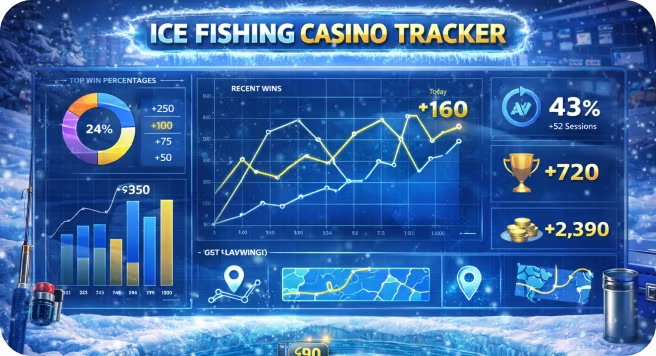
Ice Fishing Casino Tracker

| 🕐 Reading Time | ⭐ Rating | 👁️ Popularity |
|---|---|---|
| 5 minutes | 4.4 ⭐⭐⭐⭐ | 801 views |
An ice fishing casino tracker may look useful because it collects completed rounds into one place, but recorded history cannot reveal the next outcome. This guide explains what an ice fishing tracker can actually record, how ice fishing statistics are presented, and where third-party tools can create unnecessary security risks. It also examines the difference between an ice fishing game history record and a genuine prediction method. The article covers credentials, permissions, data collection, RTP, volatility, and session limits without presenting tracking as a way to gain an edge. The aim is to provide a practical way to review Ice Fishing information while keeping account and payment details protected; see the Ice Fishing page on Odds96.
What an Ice Fishing Tracker Actually Does
An ice fishing casino tracker generally collects completed-round information and presents it in a searchable or visual format. An ice fishing tracker may display the winning wheel segment, bonus category, multiplier, or timestamp when such information is available. The underlying round history is simply a record of events that have already occurred. A statistics panel can then organise those records into counts, percentages, or recent-result lists. None of these functions changes the way the official game generates its outcomes.
An ice fishing result tracker can therefore be useful for organising information, but its usefulness depends on the accuracy and source of the data. An ice fishing tracker app may rely on screen reading, manual entries, publicly available information, or another form of collection. A live casino tracker can also present information from several games in one interface. The resulting ice fishing statistics may look detailed without being complete or independently verified. The safest interpretation is that a tracker is a record-keeping tool rather than an outcome-prediction system.
Scraping and Displaying Round History
An ice fishing game history can contain a sequence of completed outcomes that is already visible through the game's interface. A third-party ice fishing tracker may attempt to copy that information and arrange it into a separate history screen. The round history can then be filtered by time, result type, or multiplier depending on the tool. An ice fishing result tracker may also calculate basic frequencies from the collected entries. These functions describe previous rounds rather than determining future ones.
An ice fishing tracker app can make historical information easier to view on a mobile device, while a live casino tracker may place several statistics on one screen. The quality of those figures depends on whether every relevant round has been captured correctly. Missing entries can distort ice fishing statistics, particularly when a sample is small. An ice fishing game history copied from an incomplete source may therefore differ from the official record. The in-game statistics panel remains the better reference when it is available.
What Data Trackers Can and Cannot See
A tracker can potentially record visible game information such as a completed segment, bonus result, multiplier, and time. It cannot legitimately see hidden game information simply because it displays an ice fishing tracker interface. An ice fishing casino tracker also cannot reveal a secret sequence that determines the next round. The official game uses its own game-generation process, while a third-party tracker operates outside that process. Claims that a tracker can see future rng outcomes should therefore be treated with caution.
An ice fishing result tracker may calculate frequencies from previously captured results, but those calculations remain historical. An ice fishing tracker app requesting account credentials is asking for information unrelated to ordinary result tracking. A live casino tracker should not require a login password simply to display public round information. Requests for unnecessary credentials can create exposure to credential phishing or account compromise. Good casino tracker safety therefore starts with limiting what information a third-party tool receives.
Where Their Numbers Come From
The numbers shown by an ice fishing tracker can originate from several sources, including manual entries, screen capture, public result feeds, or automated collection. An ice fishing casino tracker should clearly explain its source if it presents precise historical statistics. Without that information, it can be difficult to determine whether the displayed ice fishing statistics are complete. The same issue applies to an ice fishing result tracker that presents percentages without showing the underlying sample. A polished interface does not by itself establish data accuracy.
The official game information provides a more reliable basis for understanding the ice fishing game rules and available outcomes. Evolution describes Ice Fishing as a 53-segment virtual money wheel with Leaf 1, Leaf 2, Lil' Blues, Big Oranges, and Huge Reds betting options. An ice fishing tracker app cannot improve those published rules simply by displaying them differently. A live casino tracker can summarise information, but it does not become an official source merely by reproducing game statistics.
What a Tracker Can Record
Tracker information
| What it represents | Limitation | Winning segment | Completed round outcome |
|---|---|---|---|
| Does not forecast the next round | Multiplier | Multiplier attached to a result | Historical only |
| Bonus category | Bonus reached in a completed round | Does not make another bonus due | Timestamp |
When the round occurred
Does not affect probability
Frequency count
Number of recorded outcomes
Depends on data completeness
Why Tracked History Has No Predictive Power
The ice fishing game rules describe how a round progresses from betting to the wheel outcome and, where applicable, a bonus feature. Evolution states that the virtual wheel has 53 segments and that a winning wheel segment determines whether a Leaf payout or bonus game follows. An ice fishing tracker does not participate in that process. The round history only becomes available after information about a completed round has been recorded. This means a tracker can observe history without controlling the next event.
The same principle applies to ice fishing statistics collected across many rounds. A high count for one outcome does not create a requirement for a lower count in the following round. The ice fishing casino tracker may show streaks clearly because historical data is easier to notice when arranged in a list. However, independent rounds should not be treated as a balancing sequence. A statistics panel can describe frequency without providing a mathematical forecast.
Each Round Is Generated Independently
The official Ice Fishing format uses a virtual 53-segment wheel, with the wheel outcome determining the next stage of the round. This means a completed result does not provide a reliable instruction for the following result. An ice fishing result tracker can show the previous segment, but it cannot make the next segment predictable. The concept of independent rounds is therefore central when reading historical data. An ice fishing game history should be treated as a completed record.
An ice fishing tracker app may highlight repeated Leaf outcomes or frequent bonus results, making the sequence appear more meaningful than it is. The round history can contain clusters naturally without indicating that a different result is required. An ice fishing casino tracker does not alter the underlying rng or game-generation process. The same applies to an ice fishing tracker displaying a long sequence of multipliers. Historical frequency remains historical information.
Why Patterns Appear in Random Data
Random sequences do not have to alternate neatly between high and low results. Several similar outcomes can appear close together, while another outcome may remain absent for a period. Ice fishing statistics can make these clusters easier to see because they organise many rounds in one place. An ice fishing game history can therefore look as though it contains a trend even when no predictive relationship exists. This is one reason pattern hunting can become misleading.
The round history may also encourage the gambler's fallacy, where a result is considered overdue because it has not appeared recently. An ice fishing result tracker can unintentionally reinforce that impression by ranking or highlighting recent outcomes. A live game can make the effect stronger because every result arrives with visual and audio presentation. Yet independent rounds remain separate events. No tracker can turn a historical streak into a reliable prediction.
The Cost of Betting on a False Read
Using an ice fishing tracker as a prediction system can encourage larger stakes after an apparently unusual sequence. The financial risk becomes greater when an ice fishing casino tracker is treated as though it has access to information unavailable through the official game. An ice fishing result tracker may show accurate historical information while still providing no predictive advantage. The distinction matters because accurate history and accurate forecasting are completely different claims. A statistics panel should therefore be used for description rather than prediction.
A false read can also encourage chasing losses, extending a session, or increasing exposure after a large result. Session limits provide a clearer boundary than changing stakes because of a tracker display. Responsible play means treating the available balance and predetermined limits as financial controls rather than reacting to historical patterns. An ice fishing tracker app should never be allowed to dictate spending decisions. The same caution applies to any live casino tracker promising unusually precise predictions.
What Tracked History Can Tell You
- It can show previously recorded outcomes.
- It can organise ice fishing statistics into a readable format.
- It can display parts of the round history when the source is complete.
- It can help compare recorded frequencies.
- It cannot predict independent rounds.
- It cannot change the rtp or volatility of the official game.
Risks of Third-Party Tracker Tools
Third-party tracker tools create a different issue from ordinary game statistics: account and device security. An ice fishing tracker app that only displays public information presents a different risk profile from one that requests account credentials. A tool asking for passwords, one-time codes, payment details, or recovery information should be treated with particular caution. Credential phishing can make a tracker appear useful while its real purpose is obtaining account access. Casino tracker safety therefore depends heavily on what information the tool requests.
An ice fishing casino tracker does not need access to a casino account merely to display previously published results. A legitimate ice fishing tracker should not require a password to calculate basic historical frequencies from information that is already public. Requests for unnecessary credentials can expose an account to unauthorised access. They may also create opportunities for data harvesting or payment fraud. Keeping credentials away from third-party trackers is a basic part of device security.
Tools That Request Login Credentials
A tracker requesting a casino username and password should be treated as a warning sign. An ice fishing result tracker does not need private authentication information to identify a visible completed result. The same applies to an ice fishing tracker app that asks for an OTP or account recovery code. Credential phishing often relies on a legitimate-looking interface to make sensitive requests seem normal. No tracker claim is worth surrendering account credentials.
Casino tracker safety also involves avoiding password reuse between gaming and other important accounts. If a third-party live casino tracker asks for credentials, the safest approach is to stop before submitting them. The official account interface should remain the place for authentication. An ice fishing casino tracker can provide historical information without being granted account access. This separation reduces the consequences if the tracker itself is compromised.
Terms of Service and Account Standing
Third-party tools can also create questions around the terms of service of the platform hosting a game. Automated collection, scraping, account automation, or unauthorised integrations may be restricted even when the information being collected appears harmless. An ice fishing tracker should therefore be assessed not only for convenience but also for how it obtains data. The terms of service can differ between operators and may change over time. Checking the applicable rules is preferable to assuming a tracker is permitted.
An ice fishing casino tracker does not receive an automatic endorsement from the game provider simply because it displays game information. The same applies to an ice fishing tracker app available through a third-party website. If a tool requires account access or automated interaction, the potential account-standing issue becomes more significant. Reviewing the relevant terms of service before using such software can prevent avoidable problems. A simple official statistics panel usually avoids many of these complications.
Ads, Redirects and Data Harvesting
Some tracker pages may contain aggressive advertising, repeated redirects, or requests for information unrelated to their stated function. An ice fishing result tracker should not need personal payment information simply to display historical rounds. Excessive requests can indicate data harvesting rather than genuine statistical functionality. Redirects can also expose a device to phishing pages or deceptive download prompts. Good device security means avoiding unfamiliar downloads and unnecessary permissions.
The same caution applies to an ice fishing tracker app that encourages APK installation outside an established distribution channel. Data harvesting can involve contact information, identifiers, browsing behaviour, or other details that have nothing to do with round history. An ice fishing casino tracker should therefore be judged by its data practices as much as its interface. Casino tracker safety is stronger when access is limited, permissions are reasonable, and sensitive information stays private. The safest tracker is one that does not demand information it cannot reasonably need.
Pros and Cons of Third-Party Trackers
| Approach | Potential benefit | Main drawback |
|---|---|---|
| Public history tracker | Convenient review | Data may be incomplete |
| Statistics dashboard | Easier frequency comparison | Can encourage pattern hunting |
| Login-based tracker | Automated account data | Credential and account risk |
| APK-based tracker | Additional functionality | Greater device-security exposure |
| Official history panel | Direct game context | Usually fewer advanced filters |
Using Official Statistics Instead
The in-game statistics panel is generally a safer place to review information connected with completed rounds. It avoids giving a third party unnecessary access to account credentials or payment information. The official interface can also show the result in the context of the actual live game rather than through an external interpretation. An ice fishing tracker may add filters, but those filters do not make the underlying information more predictive. The round history should remain a record of completed events.
The official game information from Evolution explains the wheel structure, multipliers, and bonus mechanics directly. An ice fishing game history viewed within the official interface is therefore easier to relate to the published ice fishing game rules. An ice fishing casino tracker may reorganise the same information but does not improve the mathematical properties of the game. The statistics panel is best used to understand previous activity. It should not be treated as a signal for the next round.
The In-Game History Panel
The in-game round history can show completed results without requiring a separate tracker. Depending on the interface, the statistics panel may also provide recent-result information or related game data. An ice fishing game history entry should be interpreted according to the displayed game rules. The history can help explain what happened in previous rounds. It cannot reveal which segment will be selected next.
An ice fishing tracker app is therefore not necessary simply to keep track of visible completed results. An ice fishing result tracker can add convenience, but convenience should be weighed against privacy and security risks. The official live game interface already provides the relevant game context. An ice fishing tracker should not be considered superior merely because it displays more numbers. More numbers do not create more predictive information.
RTP and Volatility as Planning Tools
The ice fishing rtp is a mathematical measure of theoretical long-term return, not a prediction for one round. Current published rules and configurations should be checked before quoting a specific RTP figure because operator configurations can differ. Evolution's official page confirms the game's 53-segment structure and bonus mechanics but does not state one universal RTP figure on that page. The rtp should therefore be taken from the applicable published rules rather than a generic tracker claim. Volatility describes how widely results can fluctuate and should not be confused with predictability.
An ice fishing tracker cannot improve the rtp of a bet or reduce its mathematical volatility. The same applies to an ice fishing casino tracker showing a long list of previous multipliers. Historical outcomes do not change the underlying rtp or the distribution of future independent rounds. A statistics panel can help describe past activity, while volatility helps frame potential short-term variation. Neither statistic provides a guaranteed betting advantage.
Setting Limits Before a Session
Session limits are more useful for financial planning than attempting to interpret tracker patterns. A predetermined amount can define how much is available for entertainment before a session begins. The bankroll should remain separate from essential expenses and should not be increased because of a recent result. Responsible play also means avoiding attempts to recover losses by extending the session. These decisions remain valid whether or not an ice fishing tracker is being viewed.
An ice fishing result tracker should therefore have no role in deciding whether spending limits are increased. An ice fishing game history can remain available for reviewing completed rounds without influencing the budget. The statistics panel can provide descriptive information while session limits provide the actual financial boundary. A live game can be engaging without requiring constant historical analysis. Keeping those roles separate makes the session easier to control.
A Safer Review Routine
Check the official round history first.
Use the in-game statistics panel for descriptive information.
Verify the applicable ice fishing game rules from the provider or operator.
Treat ice fishing statistics as historical rather than predictive.
Keep account credentials away from third-party trackers.
Set session limits before play and follow them.
Maintain responsible play regardless of recent results.## FAQ
What is an Ice Fishing tracker?
An ice fishing tracker is a third-party tool that records or displays completed game information. An ice fishing casino tracker may organise the round history into statistics or charts.
Can a tracker predict the next round?
No. An ice fishing result tracker can analyse recorded outcomes, but independent rounds do not become predictable because historical data is displayed differently.
Are tracker sites safe to use?
Safety depends on the specific site, its data practices, permissions, and security. Casino tracker safety is weaker when a tool requests passwords, payment information, or unnecessary access.
Should I give a tracker my account login?
No. An ice fishing tracker app does not normally need private credentials to display public historical information. Requests involving credential phishing should be treated as a serious warning.
Does using a tracker breach the terms of service?
It can depend on how the tool operates and the applicable terms of service. Automated scraping, account access, or unauthorised integrations may be restricted.
Where can I see official round history?
The in-game statistics panel or history display is the appropriate first place to check completed results. The official game information also explains the ice fishing game rules and round mechanics.
What statistics are actually useful?
Ice fishing statistics can describe previous outcomes, while ice fishing rtp and volatility can help explain long-term expectations and short-term variation. They should support responsible play, not predictions.
You can also read
when-is-the-best-time-to-play-crazy-time Crazy Time peak-hour claims versus provably random wheel spins.
how-to-use-crazy-time-tracker Official Crazy Time history versus third-party tracker tools.
funky-time-tricks Funky Time bonus rounds and why past spins do not predict the next.
crazy-ball-results-today Crazy Balls result logs and how to read them without overfitting.