
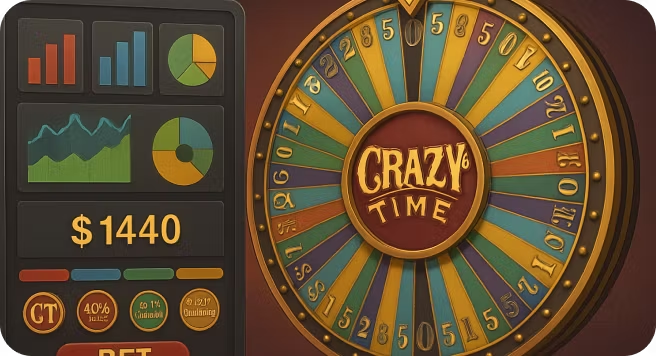
How to Use Crazy Time Live Tracker

| 🕐 Reading Time | ⭐ Rating | 👁️ Popularity |
|---|---|---|
| 5 minutes | 4.4 ⭐⭐⭐⭐ | 834 views |
Crazy Time Trackers: What They Show, How to Read Them and Their Limits A Crazy Time tracker can organize recent spins, segment frequency, and bonus round results into a readable view. This article explains how to use Crazy Time tracker tools without treating historical data as a forecast. It also covers Crazy Time statistics, Crazy Time RTP, and the difference between a short sample and a large dataset. The guide explains Crazy Time game rules alongside practical points about credential safety and casino tracker safety. Reading the data properly matters because a record of past outcomes does not change the probability of the next spin; see the Crazy Time page on Odds96.
What a Crazy Time Tracker Records
A Crazy Time tracker usually presents recent outcomes in a compact statistics panel. Depending on the tool, it may record spin history, segment frequency, bonus round occurrences, and selected multiplier information. The purpose is mainly to organize observations that are otherwise difficult to scan manually. Crazy Time statistics can therefore be useful for reviewing what has already happened during a session. They should not be treated as instructions for what to expect next.
The underlying game has four numbered segments and four bonus segments on its main wheel. The bonus options are Coin Flip, Cash Hunt, Pachinko, and Crazy Time, while the Top Slot can add multipliers to applicable outcomes. A Crazy Time tracker can record these categories, but it does not control the wheel or determine its result. This distinction is central to understanding how to use Crazy Time tracker software correctly.
Spin history and segment frequency
Spin history is simply a chronological record of previous results. Segment frequency shows how often particular outcomes appeared within the selected sample size. For example, a statistics panel might show how many times 1, 2, 5, 10, or each bonus segment appeared. This can make Crazy Time history easier to inspect than manually recording every result. However, segment frequency describes the past rather than assigning a future probability to the next spin.
A Crazy Time tracker may display frequencies over 100 spins, 1,000 spins, or another interval. The larger the sample size, the more informative the historical description can become, although randomness still remains. The same principle applies to Crazy Time stats live, where the displayed figures change as new rounds are recorded. A recent sequence can look unusually concentrated even when it falls within normal random variation. That is why spin history should be read as a record, not a signal.
Bonus round occurrences
Crazy Time has four bonus games, and the official game information states that a bonus round occurs on average about once every six spins. This average does not mean a bonus must appear after five non-bonus results. A Crazy Time tracker can count bonus round occurrences and calculate their observed frequency within a chosen sample. The resulting figure is descriptive and can differ considerably between short samples.
Crazy Time bonus frequency can therefore move above or below the long-run average during ordinary play. A tracker may show several bonus rounds close together, followed by a longer interval without one. Neither sequence creates an obligation for the wheel to compensate later. Looking at Crazy Time bonus frequency is useful for understanding the session record, but it does not establish when the next bonus round will happen.
Where the underlying data comes from
A tracker can only be as accurate as the information it receives. Some tools rely on manually entered results, while others may collect publicly displayed game outcomes through their own technical systems. Official Crazy Time statistics provide spin history and recent multiplier information directly through Evolution's statistics page. That makes the source of the data an important part of evaluating any Crazy Time tracker.
| Data type | What it records | Sensible use |
|---|---|---|
| Spin history | Previous wheel outcomes | Reviewing past rounds |
| Segment frequency | Count of each segment | Comparing samples |
| Bonus frequency | Bonus appearances | Describing session history |
| RTP | Theoretical return figure | Understanding game mathematics |
| Multipliers | Recorded multiplier outcomes | Reviewing previous results |
Crazy Time RTP is a theoretical mathematical figure rather than a promise about an individual session. Evolution currently lists 96.08% RTP for Crazy Time on its main information page, while detailed game information can show different theoretical RTP figures depending on the bet or configuration. A tracker should therefore identify the source and context of any RTP figure it displays. This is especially important when comparing a Crazy Time tracker with official information. The Crazy Time history itself remains separate from the theoretical RTP calculation.
Reading the Panel Correctly
A statistics panel can look more predictive than it really is because numbers are visually persuasive. Frequency percentages, streaks, and recent outcomes can appear to form a clear pattern. In reality, the meaning of a statistic depends heavily on sample size and how the data was collected. A 60% observed frequency across a tiny sample does not carry the same statistical weight as the same percentage across thousands of recorded spins. Good interpretation starts by asking how much data produced the number.
The idea of expected value is also useful here, although it should not be confused with a forecast. Expected value describes a mathematical average over repeated trials under defined assumptions. The house edge and RTP describe the game's long-run mathematical structure, not the result of one spin. Crazy Time statistics become more informative when viewed against those mathematical concepts rather than isolated streaks. This approach also helps avoid reading random variation as a hidden pattern.
Frequency over 100 spins vs 10,000
Suppose a Crazy Time tracker records 100 spins and shows one segment appearing far more often than another. That difference may look substantial, but a small sample can fluctuate sharply by chance. With 10,000 spins, individual swings still occur, but the overall distribution generally provides a broader picture of long-run behaviour. This is one reason sample size matters when reading Crazy Time statistics. Neither sample can tell you what the next spin will produce.
The same principle applies to Crazy Time stats live. A live panel constantly updates, so percentages can change quickly during a short run. A tracker may show 8% for one segment at one point and a substantially different figure later. Those changes do not mean the wheel has become more or less likely to land there on the following spin. They simply reflect the latest observations entering the sample.
Comparing observed frequency to expected
Observed frequency is what the tracker has actually recorded. Expected frequency is what would be anticipated over a sufficiently large number of independent spins based on the game's mathematical structure. The two figures will rarely match perfectly in a finite sample. Differences can therefore be normal rather than evidence of a mechanical problem or an approaching correction.
For practical reading, compare the same category across clearly defined samples. Keep the sample size visible and avoid mixing different game configurations or incomplete records. Crazy Time RTP should also be treated separately from observed session returns because RTP is a theoretical long-term measure. Expected value works in the same way: it describes an average mathematical outcome, not a promise for the next round.
What a deviation does and does not mean
A deviation means the observed data differs from the reference expectation. It does not automatically indicate that a segment is becoming “due” or that a different result must follow. The gambler's fallacy often begins when a normal deviation is interpreted as evidence that the wheel must correct itself. Crazy Time history can contain long streaks without changing the independence of later spins.
A useful way to read deviations is to ask three questions before drawing any meaning from them. The answers should remain focused on measurement rather than prediction.
Numbered Steps for Reading Crazy Time Statistics
- Check the sample size before interpreting any percentage.
- Identify the exact category being measured, such as a number or bonus segment.
- Compare observed frequency with the appropriate reference rather than another random streak.
- Separate historical results from RTP and expected value because they describe different things.
- Treat the next spin as a new independent event, regardless of the previous sequence.
The Line Between Data and Prediction
The most important limit of a Crazy Time tracker is that it records outcomes without controlling future outcomes. Evolution explicitly states that each Crazy Time spin is independent and that existing statistics cannot predict future results. This means even an accurate Crazy Time tracker cannot establish that a particular segment is about to appear. Historical data remains historical after the next spin begins.
That distinction matters when a tracker highlights streaks or unusually frequent segments. Such displays can be interesting for observation, but they can also encourage pattern-hunting. A live game show is designed around rapidly changing rounds, which can make recent sequences feel more meaningful than they are mathematically. Keeping the difference between description and prediction clear helps prevent that confusion.
Why the next spin ignores the history
Each main wheel spin is an independent event under the game's stated mechanics. A run of several 1 results does not make 5 more likely on the following spin. Likewise, several bonus rounds in succession do not make another bonus round impossible. Crazy Time history can document these sequences, but it cannot alter them.
This is why a Crazy Time tracker should never be presented as a forecasting mechanism. The same applies to a Crazy Time tracker app that labels outcomes as “hot,” “cold,” or “due.” Such labels may summarize recent data, but they do not change the underlying probabilities. How to use Crazy Time tracker tools responsibly therefore starts with recognizing this boundary.
How pattern-hunting increases spend
Pattern-hunting can turn a simple statistics panel into a reason for repeated betting. Seeing a long absence of one segment may create the impression that it is due. A recent cluster of bonus round results can create the opposite impression that another bonus is unlikely. Both reactions can reflect the gambler's fallacy rather than a change in probability.
The practical risk is that each new spin becomes justification for another decision. A tracker then stops being a record and becomes part of a spending loop. This is particularly relevant when Crazy Time stats live update after every round. Data is most useful when it remains descriptive rather than becoming a reason to increase stakes.
Recognising the gambler's fallacy in yourself
The gambler's fallacy is the mistaken belief that independent random events must compensate for previous outcomes. A common example is thinking that a segment absent for many spins is now more likely to appear. Crazy Time statistics cannot validate that assumption because the next spin does not depend on the displayed history. Recognising the thought pattern is more useful than trying to find a better streak indicator.
Watch for phrases such as “it has to come soon” or “it has not appeared for too long.” These statements turn a historical observation into an unsupported prediction. A Crazy Time tracker can show the absence, but it cannot supply the conclusion. Keeping that distinction intact is one of the most important parts of learning how to use Crazy Time tracker data.
Common Interpretation Errors
- Treating a short streak as a reliable pattern.
- Assuming a missing segment is “due.”
- Confusing RTP with the result of a single session.
- Ignoring sample size when comparing frequencies.
- Increasing spending because a tracker displays a recent sequence.
Choosing and Using Tools Safely
A Crazy Time tracker app should be judged by what information it requests as well as what information it displays. A simple tracker has no legitimate reason to require casino credentials merely to record publicly visible results. Credential safety should therefore be a basic screening point before entering any information. Casino tracker safety also means checking where the data comes from and whether the site's terms of service explain its operation.
Official in-game statistics provide a useful reference because they come from the game's own information environment. Evolution's Crazy Time statistics page includes spin history and recent top multipliers. (Evolution Games) A third-party tracker can still be useful for organization, but its figures should be compared with reliable source data where possible. The same caution applies to any Crazy Time tracker app promoted through unfamiliar pages.
Why no tool should ever ask for your login
A statistics tool does not need a casino account password to display historical wheel results. Entering credentials into an unrelated tracker creates an avoidable credential safety concern. Never assume that a page requesting a login is connected to the game provider simply because it uses the game's name. Check the domain, privacy information, and terms of service before providing any account details.
Casino tracker safety also involves avoiding password reuse. If a third-party page requests authentication for an unrelated statistical function, leaving the page is the safer choice. The Crazy Time tracker itself should be capable of explaining what information it collects. A request for unnecessary credentials is a clear reason to stop.
Ad-heavy tracker sites and redirects
Some tracker pages may contain aggressive advertising, repeated redirects, pop-ups, or unfamiliar download prompts. Those features do not prove that a page is malicious, but they make it harder to distinguish the actual statistics from promotional material. A clean statistics panel is easier to evaluate than a page surrounded by unrelated links. Casino tracker safety therefore includes paying attention to the browsing environment.
Do not install an application merely because a redirect claims it is required for Crazy Time statistics. A Crazy Time tracker app should have a clear publisher, understandable permissions, and a legitimate reason for collecting any requested information. Check the terms of service and privacy policy before installing anything. If the source is unclear, official Crazy Time statistics are the simpler reference point.
Sticking to official in-game statistics
Evolution provides a dedicated Crazy Time statistics page containing spin history and recent top multipliers. The official Crazy Time game information also explains the wheel, bonus rounds, RTP, and core Crazy Time game rules. These sources can be used to verify terminology and basic mathematical information shown by third-party trackers. They also reduce the need to rely on screenshots or copied figures of uncertain origin.
For anyone learning how to use Crazy Time tracker information, official data is a useful baseline. It does not make the historical figures predictive, but it helps separate genuine game information from unsupported claims. Crazy Time stats live can then be read as current observations rather than forecasts. That is the most sensible way to combine Crazy Time statistics with casino tracker safety.
Tracker Tool Pros and Cons
| Approach | Pros | Cons | Official statistics | Direct game information; clear source |
|---|---|---|---|---|
| Historical data is not predictive | Independent tracker | Convenient organization; custom views | Data quality can vary | Crazy Time tracker app |
| Easy access to recorded results | Permissions and credential safety require checking | Manual record | Simple and transparent | Time-consuming and prone to entry errors |
FAQ
What does a Crazy Time tracker actually show?
A Crazy Time tracker generally records previous outcomes and presents them as spin history or frequency data. Crazy Time statistics may include segment frequency, bonus occurrences, and multipliers. The exact fields depend on the tracker. These figures describe completed rounds. They do not predict the next spin.
How do I read segment frequency correctly?
Look at the category, sample size, and period first. Compare observed frequency with an appropriate mathematical reference rather than a recent streak. A large sample gives more context than a tiny sample. Even a large sample cannot forecast an individual result. This is the key principle in how to use Crazy Time tracker data.
Can a tracker tell me when a bonus round is due?
No. Evolution states that Crazy Time spins are independent, so past results do not determine future outcomes. Crazy Time bonus frequency can be measured after rounds have occurred. It cannot establish when the next bonus round will appear. Calling a bonus “due” is an example of the gambler's fallacy.
Are tracker sites safe?
Safety depends on the individual site, its source, permissions, and handling of information. Casino tracker safety improves when a site clearly explains its data practices and avoids unnecessary credentials. Be cautious with redirects, downloads, and unexplained permissions. Check the terms of service before installing a Crazy Time tracker app. Official statistics remain a useful comparison point.
Should a tracker ever need my account login?
There is no ordinary reason for a basic statistics tracker to require a casino password. Credential safety should take priority over access to a convenience feature. Do not enter login information into an unfamiliar tracker. Use official channels for account-related activity. This keeps the Crazy Time tracker separate from sensitive account credentials.
Where can I see official statistics?
Evolution publishes a Crazy Time statistics page containing spin history and recent top multipliers. Its game information also explains Crazy Time game rules and the game's theoretical RTP. These sources can help verify figures shown elsewhere. They should still be read as historical or theoretical information. Crazy Time stats live are not forecasts.
Does using a tracker breach the terms of service?
That depends on the specific tracker, casino, jurisdiction, and terms of service involved. Recording publicly displayed information manually is different from using software that interacts directly with a casino account. Read the applicable terms of service before using automated tools. A Crazy Time tracker should not be assumed to have permission to access an account. When in doubt, relying on official in-game statistics avoids many unnecessary access issues.
You can also read
when-is-the-best-time-to-play-crazy-time Session timing habits for Crazy Time without lucky-hour myths.
funky-time-tricks Bonus mechanics on Funky Time and why pattern hunting fails.
crazy-ball-results-today How to follow Crazy Balls results and avoid misreading streaks.
ice-fishing-casino-tracker Third-party Ice Fishing trackers versus official round history.