
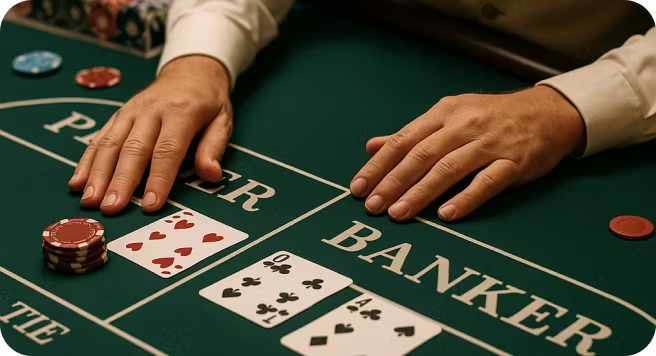
Why Baccarat Is a Top Table Game for Smart Players?

| 🕐 Reading Time | ⭐ Rating | 👁️ Popularity |
|---|---|---|
| 3 minutes | 4.2 ⭐⭐⭐⭐ | 892 views |
Baccarat remains one of the most popular casino games globally, attracting millions of players with its elegant simplicity and some of the best odds in the house. While it may look intimidating with its formal atmosphere and high-stakes reputation, the game actually offers one of the lowest house edges among all casino games, making it incredibly appealing to smart gamblers. Additionally, the straightforward nature of betting on just three outcomes: Player, Banker, or Tie creates an accessible entry point for newcomers. However, many new players struggle with understanding which bets offer real value, often falling into traps like high-risk side bets or ineffective betting systems. Without proper guidance, beginners can quickly drain their bankrolls by making poor wagering decisions or lacking a solid money management strategy.
This comprehensive guide will walk you through everything you need to master baccarat, from basic rules and optimal betting strategies to advanced bankroll management techniques. By the end, you will have a clear understanding of how to approach the game strategically, boosting your confidence and enhancing your enjoyment at the table.
Table of Contents
- Baccarat Basics: How Punto Banco & Common Variants Work
- How to Play: Rules, Card Values & Drawing Structure
- Banker vs Player Bets: Odds, House Edge, & Tie Bet Risks
- Avoid Side Bets: Why Tie & Pair Bets Hurt Your EV
- Popular Baccarat Betting Systems: Fibonacci, Martingale & More
- Bankroll Management Tips for Baccarat Sessions
- Live vs Online Play: Mini Baccarat, EZ-Baccarat & Live Dealers
- Final Thoughts
- FAQ
Baccarat Basics: How Punto Banco & Common Variants Work
Baccarat is a classic casino card game that's much simpler than it looks, revolving around a comparison between two hands: the "Player" and the "Banker". The most widespread version you'll find, especially in U.S. casinos and online at platforms like Odds96, is Punto Banco, which is purely a game of chance with fixed rules.
In Punto Banco, you don't make any decisions after placing your bet; the dealer handles everything according to a set "tableau" or board of rules. You simply wager on whether the Player's hand (Punto) or the Banker's hand (Banco) will have a point total closer to 9, or if they'll tie. The game is typically played with six or eight decks of cards shuffled together. Because the rules are predetermined, there's no skill involved in playing the hand, making it an easy game to learn.
While Punto Banco dominates the scene, a few other versions add unique twists to the gameplay:
Chemin de Fer: A French version popular in Europe, "Chemin de Fer" (which means "railway") allows players to take turns acting as the Banker. Unlike in Punto Banco, players can decide whether to draw a third card, introducing an element of skill and making the game more interactive.
Baccarat Banque: This variant is similar to Chemin de Fer but with a more permanent Banker role. One player acts as the Banker for the entire shoe or until they decide to retire or run out of money. This version adds a layer of complexity and strategy to the game.
Mini Baccarat: As the name suggests, this is a smaller and faster version of Punto Banco. It's played on a smaller table that seats fewer players and typically has lower betting limits, making it a favorite among more casual players.
Now that you have an overview of the main baccarat styles, it’s time to get into the specific mechanics of how a hand is played.
How to Play: Rules, Card Values & Drawing Structure
Getting started with baccarat is straightforward once you understand how hands are dealt and scored. The game follows a fixed set of rules, known as the "tableau," which dictates every action after you've placed your bet. This means you don't need to make any in-game decisions; you just watch the hand play out.
The goal is to bet on which hand, the Player or the Banker, will have a total closest to nine. Here’s how the cards are valued and how the game unfolds:
Card Values: The value of each hand is determined by adding the cards together. Cards 2 through 9 are worth their face value. Aces count as one point. Kings, Queens, Jacks, and 10s have a value of zero. If the total of a hand is a two-digit number, you drop the first digit. For example, a hand with a 7 and an 8 adds up to 15, so its value in baccarat is 5.
The Initial Deal: The game begins with the dealer giving two cards each to the Player and the Banker. If either the Player or the Banker has a total of 8 or 9 with their first two cards, it's called a "natural," and the round ends immediately. No more cards are drawn.
Player's Third Card Rule: If there's no natural win, the Player's hand is considered first. If the Player's total is between 0 and 5, they must draw a third card. If the Player's total is 6 or 7, they must stand and cannot draw another card.
Banker's Third Card Rule: The Banker's action depends on the Player's hand. If the Player stands (with a 6 or 7), the Banker will draw a third card if their own hand totals 0-5 and will stand on 6 or 7. However, if the Player does draw a third card, a more specific set of rules applies to the Banker:
If the Banker's total is 0, 1, or 2, they always draw a third card.
If the Banker's total is 3, they draw unless the Player's third card was an 8.
If the Banker's total is 4, they draw if the Player's third card was a 2, 3, 4, 5, 6, or 7.
If the Banker's total is 5, they draw if the Player's third card was a 4, 5, 6, or 7.
If the Banker's total is 6, they draw only if the Player's third card was a 6 or 7.
If the Banker's total is 7, they always stand.
Now that you know how a hand is played from start to finish, you can better understand where the true statistical advantages lie, which brings us to analyzing the best bets you can make.
Banker vs Player Bets: Odds, House Edge, & Tie Bet Risks
In baccarat, you have three primary betting options: wagering on the Banker's hand, the Player's hand, or a Tie. While it might seem like a simple guessing game, the math behind each bet reveals a clear optimal choice. Understanding the odds and house edge is fundamental to making smarter decisions at the table.
The numbers consistently show that the Banker bet is the most statistically sound option. It carries the lowest house edge in the game at just 1.06%. This slight advantage comes from the drawing rules, as the Banker's hand is completed after the Player's, giving it a small statistical edge. The Banker hand wins approximately 45.8% of the time, compared to the Player's 44.6%. To balance this advantage, casinos typically charge a 5% commission on winning Banker bets, but even with this deduction, it remains the best bet to make over the long term.
Your second option is the Player bet, which has a slightly higher house edge of 1.24%. While this is still very low compared to many other casino games, it's not quite as favorable as the Banker bet. A winning Player bet pays out at 1:1, so you don't have to worry about any commissions. Although the difference in the player bet edge is small, it can add up over many hands.
Finally, there's the Tie bet, which is the riskiest choice by a significant margin. The allure of a high payout, usually 8:1, tempts many players. However, the tie bet risk is substantial, with a house edge of around 14.36%. A tie occurs in only about 9.5% of hands, making it a rare event. Because of these long odds and the high advantage for the casino, experienced players almost always avoid it. If you bet on the Player or Banker and the result is a tie, your wager is returned to you in what's called a "push".
Now that the core bets are clear, it's worth examining why other betting options that might appear on the table are even less favorable.
Avoid Side Bets: Why Tie & Pair Bets Hurt Your EV
Beyond the three main wagers, many baccarat tables, including those at Odds96, offer additional side bets that promise high payouts. While the prospect of a big win is tempting, these bets come with a much higher house edge, which significantly lowers your expected value (EV) over time. For this reason, smart players know that baccarat side bets are best avoided.
The allure of side bets lies in their attractive odds, but the math reveals why they are a trap for uninformed players. Sticking to the Banker or Player bet is the foundation of any sound baccarat approach.
The High-Risk Tie Bet: As mentioned, the tie bet risk is substantial. It typically pays out at 8:1, which can seem like a great return. However, the house edge for this bet is a massive 14.36% or more, depending on the number of decks in play. A tie only occurs about 9.5% of the time, making it a rare outcome and a statistically poor choice for consistent play.
The Unfavorable Pair Bets: Another common side bet is the Pair bet, where you wager that the first two cards dealt to either the Player or Banker will form a pair. A Player or Banker Pair bet usually pays 11:1, but the house edge is approximately 10.36%. Some tables offer even more specific bets like a "Perfect Pair" (two identical cards), which might pay 25:1 but carries an even higher house edge of over 13%.
Understanding that the main bets offer the best statistical advantage is a key part of baccarat strategy, but some players try to use structured betting systems to manage their wagers, which we'll explore next.
Popular Baccarat Betting Systems: Fibonacci, Martingale & More
Many players turn to betting systems to add structure to their baccarat sessions. While it's important to remember that no system can alter the game's fixed odds or eliminate the house edge, they can help you manage your bets and define clear goals for winning and losing. Below are some popular strategies, ranging from aggressive to conservative.
Martingale Strategy: The Martingale baccarat strategy is one of the most well-known betting systems and is straightforward to use. The concept is simple: you double your bet after every loss. The idea is that when you eventually win, you'll recover all your previous losses plus a profit equal to your original stake. For instance, if you start with a $10 bet and lose, your next bet is $20, then $40, and so on. A win at any stage brings you back to your starting $10 bet. The major drawback is that a long losing streak can quickly deplete your bankroll or push you up against the table's betting limits.
Fibonacci System: The Fibonacci betting system baccarat approach is a negative progression system, meaning you increase your wager after a loss, but it's less aggressive than the Martingale. It's based on the famous Fibonacci sequence, where each number is the sum of the two preceding ones (e.g., 1-1-2-3-5-8-13...). You start by betting one unit, and if you lose, you move to the next number in the sequence for your next bet. After a win, you move back two numbers in the sequence. This method helps you recoup losses more slowly and with less risk of bets escalating too quickly.
Paroli System: In contrast to the systems above, the Paroli is a positive progression strategy designed to capitalize on winning streaks. You start with a fixed base stake and double your bet after every win. The common rule is to stop after three consecutive wins and return to your original stake, locking in your profit. If you lose a bet at any point, you immediately go back to your starting base stake. This keeps losses minimal while maximizing gains during a hot streak.
Labouchere System: Also known as the cancellation system, the Labouchere is a bit more complex but allows you to set a specific profit target. First, you decide how much you want to win and break it down into a sequence of numbers (e.g., to win $50, you might write down 5-10-20-10-5). Your bet is the sum of the first and last numbers in your list. If you win, you cross those two numbers off; if you lose, you add the amount you just lost to the end of the list. The goal is to cross off all the numbers, at which point you've reached your profit goal.
D'Alembert System: The D'Alembert system is another negative progression strategy, but it's much flatter and less risky than the Martingale. You start by choosing a base betting unit. After a loss, you increase your next bet by one unit. After a win, you decrease your next bet by one unit. The theory is that once you have an equal number of wins and losses, you will be in profit by the number of bets you've won. It's favored by players who want to avoid the rapid bet increases seen in other systems.
1-3-2-6 System: This is a positive progression system designed to profit from short winning streaks, specifically a run of four wins. The numbers in its name refer to the betting sequence in units. You start with a 1-unit bet. If you win, your next bet is 3 units, then 2, then 6. If you lose at any point in the sequence, you go back to the beginning with a 1-unit bet. The biggest advantage is that your risk is limited to two betting units, and a successful four-win streak results in a profit of 12 units.
Using any of these systems requires discipline, and no strategy is complete without a solid plan for managing your money, which we'll cover next.
Bankroll Management Tips for Baccarat Sessions
Regardless of the betting system you prefer, none of it matters without proper bankroll management. This is the practice of managing your gambling funds to ensure you can play longer, minimize losses, and walk away from the table at the right time. Since baccarat has a low house edge, smart money management can significantly improve your playing experience.
Here are some essential tips for managing your money during baccarat sessions:
Only Bet What You Can Afford to Lose: This is the most important rule of any form of gambling. Your baccarat bankroll should be money set aside specifically for entertainment, separate from your funds for living expenses. Never dip into money you need for other things.
Set Strict Win and Loss Limits: Before you start playing, decide on a stop-loss limit (the maximum amount you're willing to lose) and a stop-win limit (a profit target at which you'll cash out). For example, you might start with a $200 session bankroll and decide to stop if you lose $100 or win $100. Sticking to these limits prevents you from chasing losses and protects your winnings.
Divide Your Bankroll for Each Session: Don't take your entire gambling budget to the table at once. A good practice is to divide it into smaller amounts for individual sessions. For instance, if you have a total bankroll of $1,000, you might decide to only risk 10% of it, or $100, per session.
Use a Consistent Bet Size: A simple and effective strategy is flat betting, where you wager the same amount on every hand regardless of wins or losses. This approach helps your bankroll last longer and prevents the rapid losses that can occur with aggressive betting systems. A good rule is to never bet more than 5% of your session bankroll on a single hand.
Avoid Emotional Decisions: It's easy to get caught up in the excitement, but making bets based on emotion is a quick way to deplete your funds. Chasing losses by increasing your bet size after a losing streak is a common mistake that rarely pays off. Stick to your predetermined limits and strategy.
With a solid bankroll management plan in place, you can approach the game with discipline. Now, let's look at how the baccarat experience differs depending on where you play.
Live vs Online Play: Mini Baccarat, EZ-Baccarat & Live Dealers
The baccarat experience can feel quite different depending on where you choose to play. Whether you're at a traditional casino or playing online, each environment offers unique characteristics. Understanding the variations, especially popular options like Mini Baccarat, EZ Baccarat, and live dealer games, helps you pick the right fit for your playing style.
Mini Baccarat: Fast-Paced Fun: Mini Baccarat offers a quicker version of the classic game. You'll find it on a smaller table with fewer players, and the dealer handles all the cards, which really speeds things up. This version often comes with lower betting limits, making it a great starting point if you're new to baccarat or if you prefer to play with a smaller bankroll.
EZ Baccarat: Commission-Free Play: EZ Baccarat gives a popular twist to the game by eliminating the 5% commission usually charged on winning Banker bets. This means you get the full payout for your winning Banker wagers. However, to balance this, if the Banker wins with a three-card total of 7 (known as a "Dragon 7"), your Banker bet becomes a "push" or a tie, and your wager simply returns to you. EZ Baccarat also introduces special side bets, like the Dragon 7 and Panda 8, which can offer big payouts but generally have a much higher house edge than the main bets.
Live Dealer Baccarat: Real Casino Feel at Home: Live dealer baccarat, often available at online casinos like Odds96, combines the best of both worlds. You play online, but a real human dealer manages the game through a live video stream. This setup provides a more authentic casino experience and lets you see the cards shuffled and dealt in real-time, which many players appreciate for its transparency. You can also interact with the dealer and other players using a chat feature, adding a social element to your online play.
Here’s how these different formats compare:
| Variant | Pros | Cons |
|---|---|---|
| Mini Baccarat | Lower betting limits make it more accessible | Fast gameplay can lead to quicker bankroll depletion |
| Faster gameplay allows more hands per hour | Less social interaction than larger baccarat tables | |
| Simple rules and easy table layout | ||
| EZ Baccarat | No 5% commission on Banker wins | Dragon 7 rule can result in a push on some Banker wins |
| Slightly lower house edge (~1.02%) on Banker bet | Side bets have very high house edge | |
| Exciting high-payout side bets | ||
| Live Dealer | Authentic casino experience with real dealers | Requires stable internet connection |
| Increased transparency (live gameplay) | Tables may be full; waiting required | |
| Social interaction via chat | Slower pace than digital versions |
Ultimately, the best format comes down to your personal preference for game speed, betting limits, and social interaction. Trying out a few different styles, like the various options available at Odds96, is a great way to find the experience that best fits your playstyle. This ensures your baccarat sessions are not only strategic but also genuinely enjoyable.
Final Thoughts
Baccarat's appeal lies in its simplicity and favorable odds, making it accessible to both newcomers and experienced players. By focusing on the Banker or Player bets while avoiding high-risk side wagers, you can maximize your chances of success. Smart bankroll management and understanding the different game formats will help you play more confidently and enjoyably. Whether you choose to play at a traditional casino or explore the convenient options available at Odds96, applying these strategies will enhance your baccarat experience and help you make more informed decisions at the table.
FAQ
What are the main baccarat variants I should know?
The three primary baccarat variants are Punto Banco, Chemin de Fer, and Baccarat Banque, though you'll most often encounter Punto Banco at casinos like Odds96.
Is betting on Banker always the best choice?
Yes, betting on the Banker is generally the best choice because it has the lowest house edge at 1.06%, even with a 5% commission on winnings.
Why should I avoid tie or pair side bets?
You should avoid tie and pair side bets because they carry a significantly higher house edge, often around 14.36% for the tie bet and over 10% for pair bets, making them statistically poor choices.
Can betting systems like Martingale reduce losses?
Betting systems like Martingale can help manage bets and potentially recover short-term losses, but they do not eliminate the house edge or guarantee profits, and a long losing streak can quickly deplete your bankroll.
How do I manage bankroll in baccarat to avoid tilt?
To manage your bankroll and avoid tilt, only bet money you can afford to lose, set clear stop-loss and stop-win limits, and consider using a consistent bet size.