
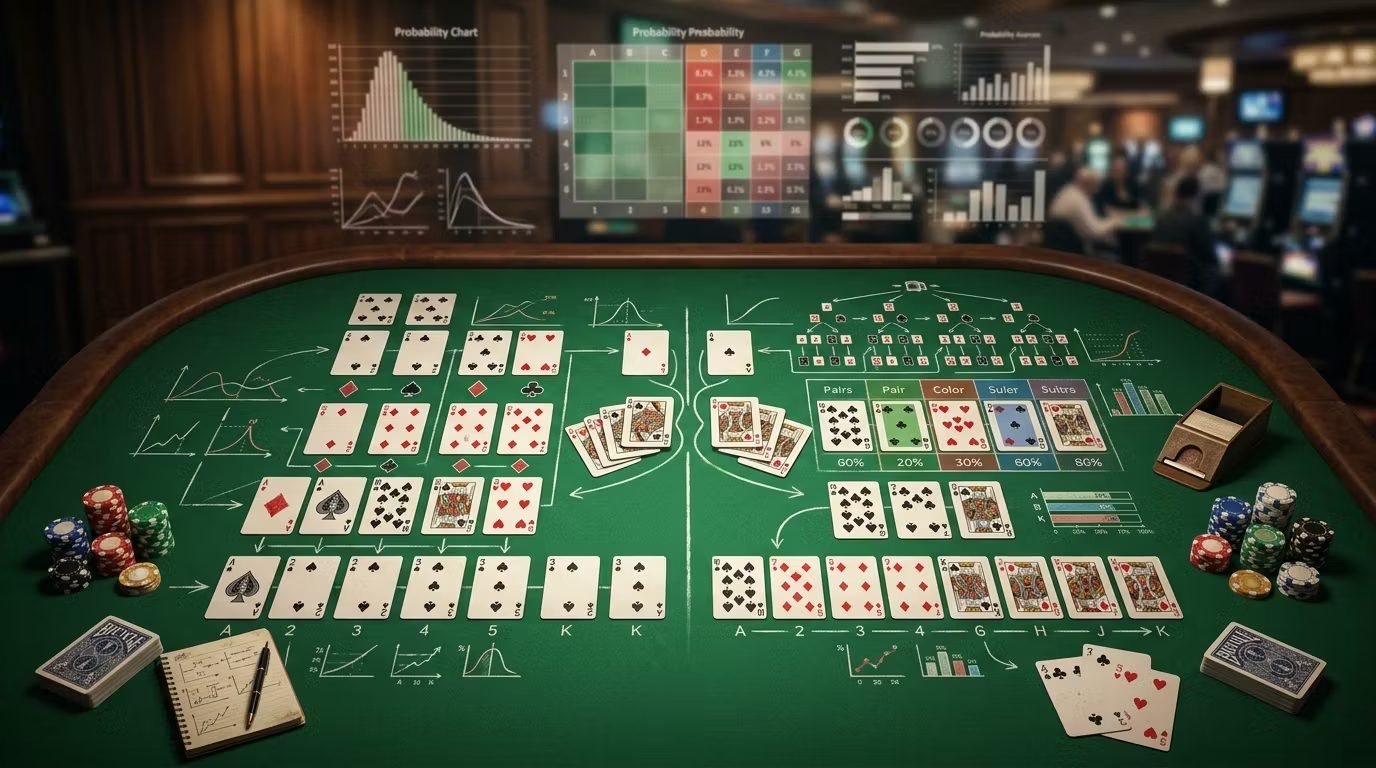
Andar Bahar Tricks Chart: RTP, Side Bets and Winning Systems Explained

| 🕐 Reading Time | ⭐ Rating | 👁️ Popularity |
|---|---|---|
| 3 minutes | 4.3 ⭐⭐⭐⭐ | 789 views |
Andar Bahar is a long-established Indian card game with a simple choice: bet on whether the matching card will appear on Andar or Bahar. Online and live-dealer versions keep the same chance-based core while making each round quick to follow.
An Andar Bahar tricks chart cannot predict the next card, but it can make the available bets easier to compare. Looking at RTP, house edge, side-bet ranges, and common betting systems helps players understand the trade-offs and manage their cash balance without treating any approach as a guaranteed route to winning.
Table of Contents
| Understanding RTP and House Edge in Andar Bahar | | Side Bet Ranges: Why 16–20 and 6–10 Offer Better Value | | Visual Tricks Chart: Simplifying Bet Selection at a Glance | | Popular Betting Systems: Martingale & Hot-Cold in Chart Form | | FAQ |
Understanding RTP and House Edge in Andar Bahar
RTP, or Return to Player, is a theoretical long-term percentage rather than a forecast for an individual session. House edge describes the mathematical advantage built into the game. Together, these figures help compare bets, but they do not remove short-term variance.
The stated RTP for the main Andar bet is around 97.85%, while the Bahar bet is about 97.00%. Exact figures may differ between casino versions because dealing rules and payouts can vary.
Side bets usually offer larger payouts in exchange for lower probabilities. The stated RTP is 92–94% for the 1–5 range, 96–97% for 6–10, 95–96% for 11–15, and 97–98% for 16–20. It falls to 94–95% for 21–25 and 92–93% for ranges of 26–30 or higher. On those figures, 6–10 and 16–20 compare more favourably with the other listed side-bet ranges, although either can still lose on any round.
Side Bet Ranges: Why 16–20 and 6–10 Offer Better Value
Ranges above 25 may attract attention because of their larger potential payouts, but the matching card is less likely to arrive that late. The 6–10 and 16–20 ranges offer a different balance between the stated payout and probability.
Why 6–10 works well
It is statistically more likely than the volatile 1–5 range.
Payouts are often stated as 4:1 or 5:1.
Smaller stakes can help protect the cash balance during an unlucky run.
Why players compare 16–20
The stated RTP data places this range above the other listed side bets.
Payouts are often stated as 10:1 or better.
Its probability is higher than that of the extreme ranges above 25.
Side-bet approach
✅ Choose 6–10 when you prefer a lower-volatility option among the listed side bets.
✅ Consider 16–20 when its payout and stated RTP suit your risk limit.
❌ Avoid relying on 30+ ranges as a regular strategy; they remain highly volatile.
Visual Tricks Chart: Simplifying Bet Selection at a Glance
Charts are powerful tools in Andar Bahar because they eliminate guesswork and streamline decision-making. In fast-paced live games, hesitation can lead to missed opportunities or impulsive bets. By having a tricks chart at your disposal, you can instantly see which bets offer the best value and which to avoid, letting you focus on strategy rather than second-guessing. Beyond just guiding bet selection, charts also help players track patterns and manage risk more effectively, making the overall gameplay experience more structured and confident.
Benefits of a Tricks Chart
· Quick decisions: Great for fast-paced live games, allowing you to act instantly without overthinking.
· Cash balance discipline: Prevents impulse bets on high-risk ranges, keeping your funds managed wisely.
· Confidence: Beginners can follow a consistent process instead of relying on guesswork.
· Pattern recognition: Makes it easier to see which bets align with your risk level and preferred strategies.
By combining visual cues with probability insights, a tricks chart can organise bet selection. It does not predict the cards or change the underlying odds.
Popular Betting Systems: Martingale & Hot-Cold in Chart Form
Betting systems in Andar Bahar do not alter the underlying odds of the game. They only change how stake sizes are managed after wins or unlucky rounds. Martingale and Hot-Cold are two commonly discussed examples.
The Martingale system doubles the next bet after every unlucky round. If the opening stake is ₹100, the progression becomes ₹200 and then ₹400. A later win may recover earlier stakes when an even-money payout applies, but there is no assurance that the win will arrive before the cash balance or table limit ends the sequence. The required stake grows quickly, making extended progressions particularly risky.
The Hot-Cold method tracks recent streaks. A player may continue with a “hot” result or switch because another result appears “overdue.” Previous cards do not guarantee the next outcome, so these observations should not be treated as predictive signals.
Here is a clear overview of the pros and cons of these popular betting systems:
| System | Pros | Cons |
|---|---|---|
| Martingale | - Simple structure - High short-term recovery rate - Works with even-money bets | - Requires huge cash balance - Risks catastrophic losses - Table limits break progression |
| Hot-Cold | - Fun and engaging - Uses streaks to guide bets - Works for casual players | - No mathematical basis - Can mislead into chasing losses - RTP unchanged |
Neither system improves RTP or puts the odds in the player’s favour. Set a stake limit before playing, avoid chasing previous results, and treat Andar Bahar as entertainment rather than a source of income.
FAQ
What is the purpose of an Andar Bahar tricks chart?
It simplifies betting choices by showing RTP values, side bet ranges, and betting systems in one glance.
Which side bet range gives the best long-term RTP?
The 6–10 and 16–20 ranges provide the most balanced RTP and probability.
How can a chart help manage your cash balance during gameplay?
It discourages impulse bets on high-risk outcomes and helps structure betting according to the available cash balance.
Is Andar Bahar still a game of chance despite having chart-based tips?
Yes. Andar Bahar is fundamentally chance-based. Tricks charts only help organise decisions and manage risk.
Can a tricks chart make Andar Bahar predictable?
No. It can’t predict outcomes—it only helps compare bets. The randomness of card draws remains.
What else can I read related Andar Bahar Game?
We've prepared Andar Bahar theme articles to help new and regular players in this game: